Independent information / Modest claims
About: Our Small-Scale Purpose
Vaulthoppercompassran.mom is a place for curious model makers to examine what reclaimed materials can do, one small controlled experiment at a time.
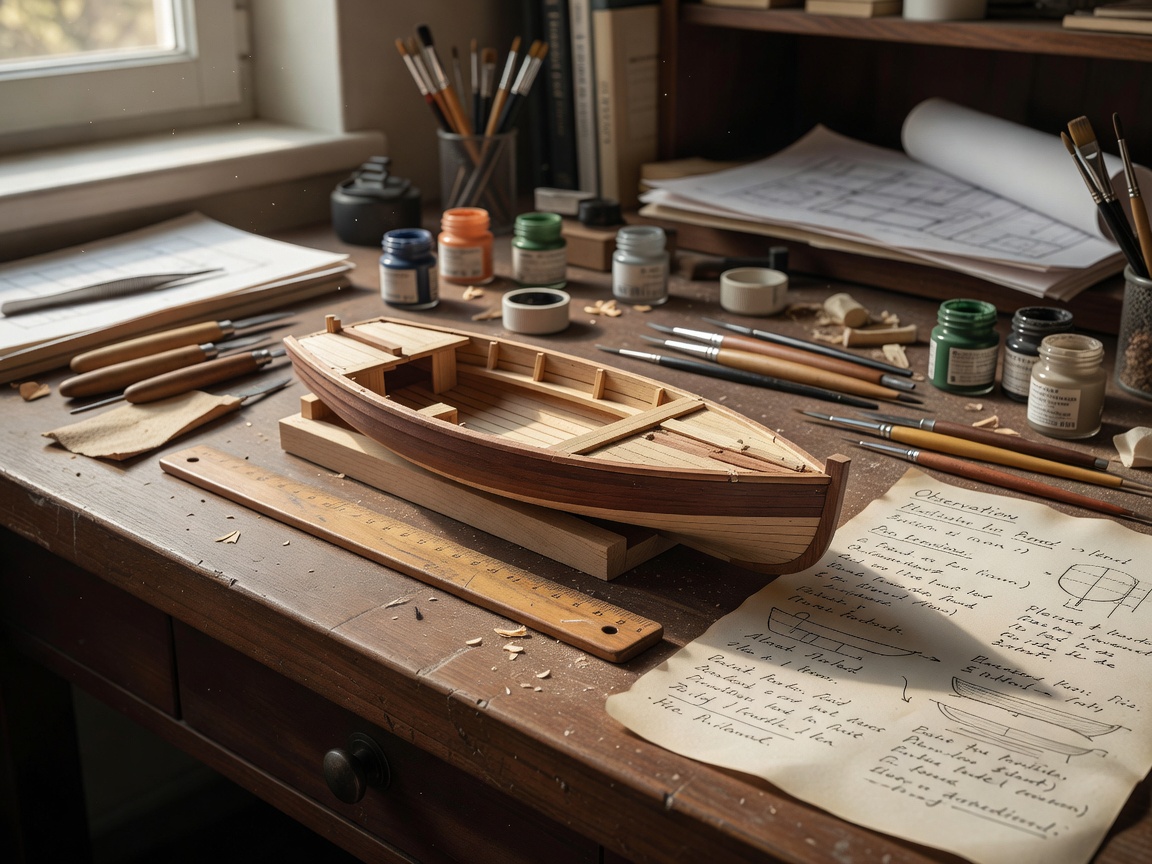
Observe before improving
Our guides connect simple construction with visible behavior: a rising waterline, a tilted deck, a damp seam or a hull that drifts away from its heading. The goal is not a perfect miniature on the first attempt. It is an understandable experiment with a useful next step.
We favor known, clean leftovers over anonymous scrap, reversible assemblies over unnecessary glue and short controlled tests over outdoor releases.
This website is an independent informational project, not a boatyard, naval-architecture practice, certification body or emergency service. We do not present these illustrative projects as laboratory-validated designs.
What the pictures mean
Plain-background model images are illustrative renders. They show a concept or assembly relationship; they are not evidence of a completed physical build, a verified product or a successful load test. Reference photographs provide material or boating context and should not be read as construction instructions.
What we do not claim
These projects do not certify seaworthiness, flotation equipment or passenger-carrying capacity. We do not recommend taking models into rivers, harbors or the sea. Reclaimed material varies, and product labels, local requirements and competent supervision remain essential.
Reference shelf
The following established resources provide background or routes to further reading. Mention does not imply affiliation, endorsement or that a particular model complies with a standard.
- Archimedes and the principle of displacement are the starting point for buoyancy observations; Encyclopaedia Britannica offers an introduction.
- Royal Museums Greenwich, including the National Maritime Museum and Cutty Sark, offers maritime history and vessel context.
- Smithsonian Magazine and the National Museum of American History provide broader historical and technical reading.
- Royal National Lifeboat Institution and the U.S. Coast Guard Boating Safety Division publish water-safety information for their respective contexts.
- Royal Yachting Association and American Sailing Association provide pathways to practical sailing education, separate from these model exercises.
- National Oceanic and Atmospheric Administration and the National Ocean Service explain tides, currents and coastal science.
- U.S. Environmental Protection Agency and WRAP provide information about materials, reuse and waste reduction.
- ASTM International publishes material standards, including ASTM D7611/D7611M on resin identification coding. Identification is not a bonding guarantee.
- International Organization for Standardization publishes the ISO 12217 small-craft stability and buoyancy series. It is not replaced by these model observations.
- American Boat and Yacht Council develops recreational-boating standards; Gougeon Brothers publishes technical background on wood and epoxy systems.
Send a correction, not a risky challenge
If a passage is unclear, tell us which page and what you observed. We welcome specific material identifications, clearer explanations and safety corrections. Please do not repeat a failed test just to produce a dramatic photograph.
Draft a build note